If you just received a California Wood Destroying Organism (WDO) report or a termite proposal, a couple of lines may have caught your eye: fumigation listed as the “primary” method of control, and localized treatment listed as “secondary” and done “at owner’s request.” It is natural to wonder whether your inspector is quietly telling you to tent the house. That wording comes from California’s disclosure rules, and on its own it is not a recommendation to tent.
This guide explains what those WDO report lines really mean, what a localized (drill-and-foam) drywood termite treatment includes, and how it compares with tenting. Treebark Termite and Pest Control serves Los Angeles, Orange, and Riverside Counties. We focus on localized termite control and when a job does need tenting we arrange fumigation through a licensed partner, so we will give you the straight version of both options.
Call now: Call or text Treebark Termite and Pest Control at (888) 559-8816.
Why your WDO report calls fumigation the “primary” method
The State of California recognizes fumigation as the only method of control that takes one treatment. That is the reason fumigation shows up as the “primary” method on WDO reports.
All WDO reports should also note that multiple treatments might be needed to control drywood termites, because a colony may be missed during the initial treatment. Seeing that note on your report does not mean something went wrong. It is standard wording.
Why localized treatment is listed as “secondary”
Because the State only recognizes fumigation as a one-initial-treatment service, any localized treatment is legally considered secondary. By law, we have to disclose this on the report, which is where the “secondary method … at owner’s request” language comes from. When Treebark proposes a localized treatment, we are not recommending tenting; we are following the disclosure rules.
What a localized drywood termite treatment includes
- Every infestation we locate during the inspection is treated.
- Unfinished wood framing in the substructure, attic, and garage is treated preventatively.
- Hard-to-reach areas: any infestation leading into an inaccessible area, such as a wall void, ceiling, or other enclosed space, is foam-treated with a termiticide labeled for that use.
If you want background on the inspection itself and how WDO reports are organized, see our termite inspection page.
Will there be drill holes?
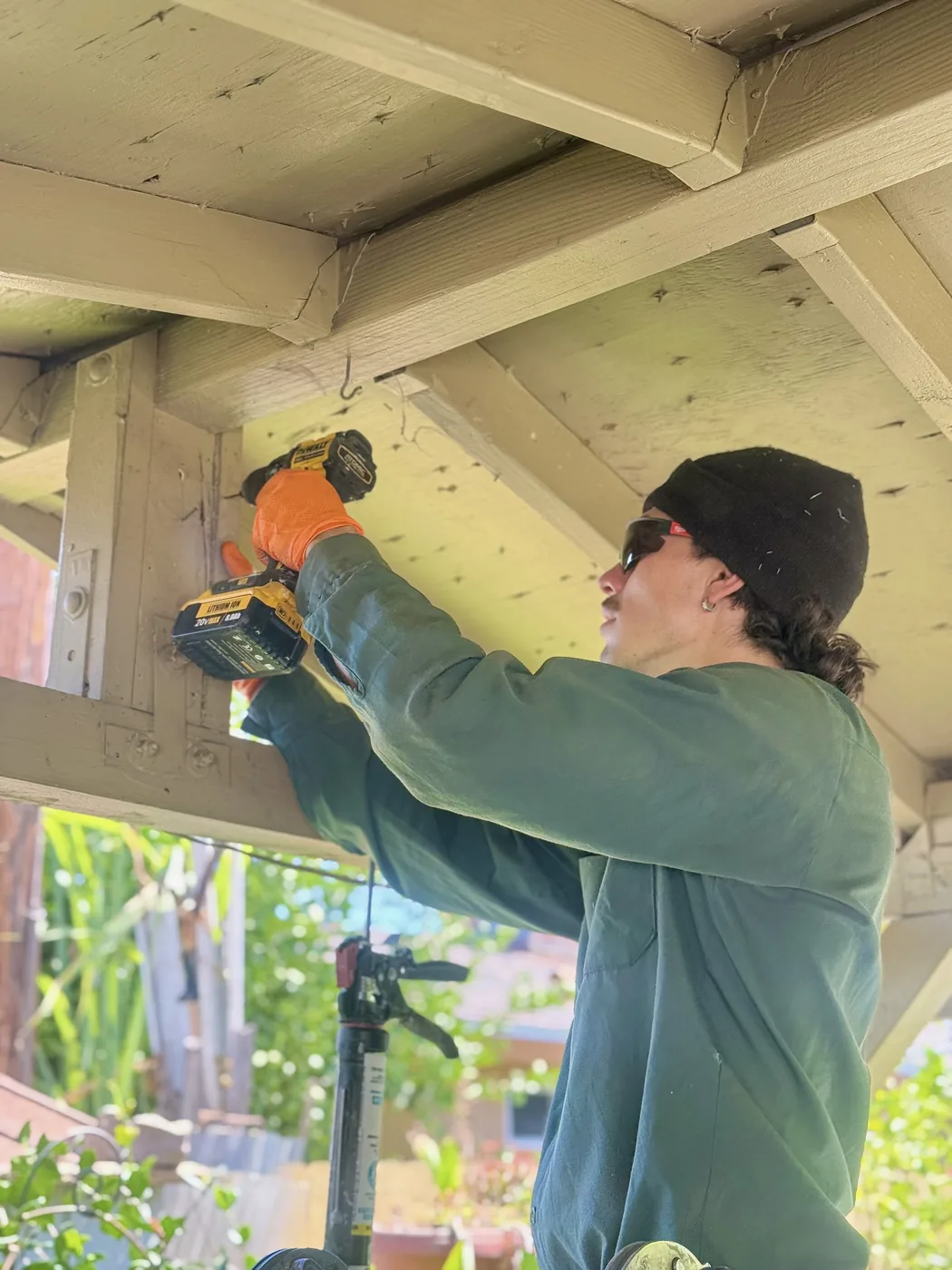
Not indiscriminately. We drill and inject only the areas surrounding an infestation, so the product encircles the colony. Holes are patched, repaired, and left ready for paint. Drilling is targeted to the infestation, not done across the whole house.
What “cover and remove visible and accessible evidence” means
You may see this phrase on a proposal. It means vacuuming up termite droppings (frass, or pellets) and other termite evidence in the attic, garage, and subarea. Clearing out the old evidence makes it possible to tell old activity from new activity later on.
Repairs and touch-ups
Whether repairs are needed depends on the extent of the wood damage. Drill holes are patched and prepared for paint, and you may want to paint or touch up repaired or treated areas afterward.
Localized treatment vs. tenting: a fair comparison
Cost is often comparable, so the decision usually comes down to preference. Both methods are heavily regulated, and both require extensive insurance, bonding, and licensing with continuing education.
Localized treatment
- Pros: reduced-risk termiticides; convenient; a long-lasting preventative residual; proven results when paired with ongoing inspection programs.
- Cons: a colony may be missed, so secondary treatments may be needed; drill holes in wood members.
Fumigation (tenting)
- Pros: one tent, typically 3 days and 2 nights.
- Cons: no lasting residual once the tent comes down; fumigations can still fail; some risk to roofs, plants, and property during tenting.
Treebark doesn’t perform fumigation itself. Some jobs do need it, and when yours does, we arrange it through a licensed partner, so you still deal with one company. If you are weighing both options, we are glad to walk you through your report so you can decide with the full picture.
What warranty comes with Treebark’s localized treatment?
Our localized treatment comes with a 1-year transferable warranty. If any colony remains during that year, we come back and treat it at no additional charge. After the first year, you can choose an optional annual renewal plan: a maintenance program that includes yearly inspections and any additional treatments or service needed. Our promise is simple: if the termites return, so do we.
Have a WDO report or termite proposal with questions like these?
Call or text (888) 559-8816 now.
Or start on our Drywood Termite Treatment page.
Quick FAQ
Does “primary method” mean my inspector wants me to tent?
Not on its own. California recognizes fumigation as the only one-treatment method of control, so reports list it as primary. Localized treatment has to be listed as secondary by law.
Can localized treatment reach termites inside walls?
Yes. When an infestation leads into an inaccessible area such as a wall void, ceiling, or enclosed space, it is foam-treated with a termiticide labeled for that use.
Is localized treatment cheaper than tenting?
Not necessarily. Cost is often comparable, so the choice usually comes down to preference.
Get help from Treebark
If you are in Los Angeles, Orange, or Riverside County and want a second look at a WDO report or a localized treatment proposal, Treebark is ready to help.
Call now: (888) 559-8816
Drywood Termite Treatment · Termite Control
This article is general education about California termite treatment options. It is not legal or real estate advice. Your WDO report, proposal, and contract describe the specific work for your property.
Get Treebark updates in Google Search